Photo Credits: Getty Images
Who Gets to Be a Pan-Africanist?
Bravin Onditi
2026-05-11
There is a word that has been spoken by freedom fighters in prison cells, by intellectuals in Paris, by trade unionists in Manchester, and by heads of state in Addis Ababa — and most recently, and most controversially, by a French president standing beside a Kenyan counterpart in Nairobi. That word is Pan-Africanist. But what does it actually mean to wear that name? And who has the right to claim it?
Pan-Africanism did not begin as a government policy. It began as a cry — the cry of people torn from their homeland and stripped of their names, who dared to imagine that Africa was still one. The Haitian Revolution of 1791–1804, in which enslaved Africans overthrew their French masters and founded the first Black republic in the Western Hemisphere, was Pan-Africanism in action long before it was Pan-Africanism in theory.
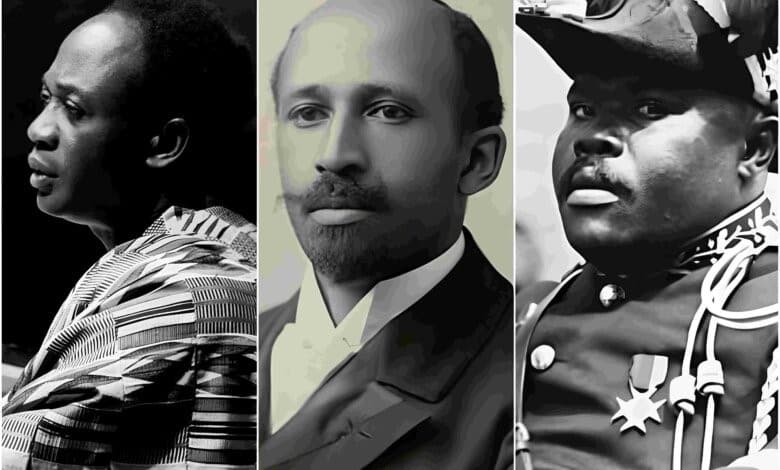
The formal intellectual tradition is traced to the late nineteenth century, when figures like Edward Wilmot Blyden began arguing for the unity of African peoples across the world. The movement took organised shape in 1900, when a Trinidadian barrister named Henry Sylvester Williams convened the first Pan-African Conference in Westminster Town Hall, London. Among the delegates was a young American scholar named W.E.B. Du Bois — the man who would become the father of the modern Pan-African movement. Du Bois understood that the oppression of Black people in America, in the Caribbean, and in colonial Africa were not separate problems but one problem wearing different masks. While Du Bois built Pan-Africanism in conference halls, Marcus Garvey built it on street corners. The Jamaican-born organiser founded the Universal Negro Improvement Association (UNIA) in 1914 with his partner Amy Ashwood, and by the 1920s it had grown into the largest Pan-African organisation in history. His slogan "Africa for the Africans, those at home and those abroad" would later inspire Nkrumah, Kenyatta, Malcolm X, and the Rastafarian movement.
The Congresses
Between 1919 and 1945, Du Bois organised a series of Pan-African Congresses in Paris, Brussels, London, Lisbon, and New York. The First Congress of 1919 was timed to coincide with the Versailles Peace Conference, where European powers were redrawing the world's borders without a single African voice at the table. Running alongside these political congresses was a parallel cultural revolt. In 1930s Paris, three Francophone writers — the Martinican poet Aimé Césaire, the Senegalese Léopold Sédar Senghor, and the French Guianese Léon Damas — founded the Négritude movement, insisting that African culture was a civilisation of its own.
The Fifth Pan-African Congress of October 1945, held in Manchester, was the turning point. Organised by George Padmore, Kwame Nkrumah, and Jomo Kenyatta — and shaped by women like Amy Ashwood Garvey, who co-chaired the opening session — the tone was no longer polite. The delegates demanded the end of colonialism, now.
Pan-Africanism Comes Home
In December 1958, Kwame Nkrumah, now Prime Minister of newly independent Ghana, convened the All-African Peoples" Conference in Accra. Where earlier conferences had been attended only by governments, the AAPC opened its doors to liberation movements, trade unions, and youth organisations. Among those profoundly shaped by it was a young Congolese politician named Patrice Lumumba.
But independence did not bring unity. By 1961, African states had split into two camps. The Casablanca Group — Nkrumah of Ghana, Nasser of Egypt, Sékou Touré of Guinea — demanded an immediate, federal United States of Africa. The Monrovia Group — led by Nigeria, Liberia, and Côte d"Ivoire — argued for gradual cooperation that preserved national sovereignty. When the two camps met in Addis Ababa on May 25, 1963 to found the Organisation of African Unity, it was the Monrovia vision that prevailed. Nkrumah's dream of a continental government was deferred — and remains deferred. That date became Africa Day, now observed each year across the continent and its diaspora. When the OAU was transformed into the African Union in 2002, the date remained. Today, Agenda 2063 and the African Continental Free Trade Area are described by the AU itself as the institutional embodiment of "the pan-African drive for unity, self-determination, freedom, progress and collective prosperity."
So, Who Is a Pan-Africanist?
A Pan-Africanist is someone who believes in the fundamental unity and shared destiny of African peoples across the continent and the diaspora — someone who understands that slavery, colonialism, neo-colonialism, and racism are not separate chapters but one continuous story. They work toward African political self-determination, economic sovereignty, and cultural dignity. They understand that foreign investment without African ownership is not development — it is a new form of extraction wearing a friendlier suit.
The tradition runs from Du Bois and Padmore to the Martinican revolutionary Frantz Fanon, the Trinidadian historian C.L.R. James, the Guinea-Bissauan revolutionary Amílcar Cabral, the Guyanese scholar Walter Rodney, to heads of state like Nkrumah and Julius Nyerere — and to Thomas Sankara of Burkina Faso, who at the 1987 OAU summit declared that "debt is a cleverly managed reconquest of Africa." Three months later, he was assassinated. The tradition also runs through women whose names history has tried to bury: Funmilayo Ransome-Kuti, Amy Jacques Garvey, Constance Cummings-John, Charlotte Maxeke. The defining characteristic of a Pan-Africanist is not where they were born. It is whose interests they consistently defend, and whose structures they are willing to dismantle.
Macron: "We Are the True Pan-Africanists"
Which brings us, unavoidably, to Nairobi, May 2026. At a press conference alongside Kenyan President William Ruto ahead of the Africa Forward Summit, French President Emmanuel Macron declared, "We are the true Pan-Africanists." The summit, held on May 11 and 12, was the first Africa-France summit ever hosted in an English-speaking African country, and the first held against the backdrop of France's expulsion from the Sahel — military regimes in Mali, Burkina Faso, and Niger having shown French troops the door between 2022 and 2023. Macron announced a $27 billion investment package covering energy, artificial intelligence, and agriculture. But Pan-Africanism has never been impressed by the size of a cheque. It asks: Who controls the assets? Who sets the terms? Who benefits most?
France's relationship with Africa is not merely historical baggage. It is a living architecture of dependency. The most concrete symbol is the CFA Franc — a currency used by 14 African nations, pegged to the Euro and until recently backed by the French Treasury, with African countries required to deposit half their foreign exchange reserves in Paris. In December 2019, Macron and Ivorian President Alassane Ouattara announced a "historic" reform, renaming the West African version the Eco. But economists like Ndongo Samba Sylla argue the reform was largely cosmetic — the currency remains pegged to the Euro, France retains a convertibility guarantee, and the Central African version is entirely untouched. A man who leads a country that administers such a system cannot, with intellectual honesty, claim the tradition of men and women who spent their lives fighting systems exactly like it.
There is also something deeply revealing in Macron's conduct at the summit itself. Beyond the "Pan-Africanist" claim, he stormed a panel stage to rebuke African audience members for what he called a "total lack of respect." The image of a European leader, on African soil, publicly scolding an African audience tells its own story. Pan-Africanism was built precisely on the rejection of this kind of paternalism. By the only measure that matters, Emmanuel Macron is not a Pan-Africanist. He is a skilled diplomat representing the interests of a country with enormous stakes in maintaining African dependency. Calling oneself a Pan-Africanist while leading a country that continues to benefit from structural arrangements that Pan-Africanism exists to dismantle is not a political position. It is a contradiction.
The Living Meaning
When former colonial powers begin to speak the language of Pan-Africanism, it is a sign of something important: the ideas have won enough ground to be worth co-opting. That is, in its way, a testament to the movements endurance. But the co-option is also a danger. If Pan-Africanism becomes a word that anyone can claim — regardless of structural position or genuine commitment to African sovereignty — then it loses its edge. It becomes decoration rather than weapon. A Pan-Africanist is someone who stands clearly and consistently on the side of African peoples' right to determine their own political futures, control their own economies, and celebrate their own cultures — not as a favour granted by former colonial powers, but as an inalienable birthright that no summit declaration can substitute for.