Photo Credits: Luis Tato/Getty Images
What the Numbers Say About Sudan's Unravelling
Bravin Onditi
2026-04-15
On April 15, 2023, fighting broke out in Khartoum between the Sudanese Armed Forces and the paramilitary Rapid Support Forces. As the war enters its fourth year, Sudan now carries a grim distinction: the world's largest humanitarian and displacement crisis, one that the UN's own relief coordinator has called an 'abandoned crisis.' The numbers are not just statistics. They are a reckoning. This analysis draws on a landmark special report - Beyond the Conflict: Charting a Path to Sustainable Growth and Development in Sudan published in 2026 by the African Futures & Innovation Programme at the Institute for Security Studies. Using the International Futures forecasting platform, the report models Sudan's long-term development trajectory across three scenarios: the Current Path, a Sudan Rising recovery scenario, and a Protracted Conflict scenario extending to 2030. What emerges is not simply a portrait of a country at war. It is a warning about what happens when the international community watches and waits.
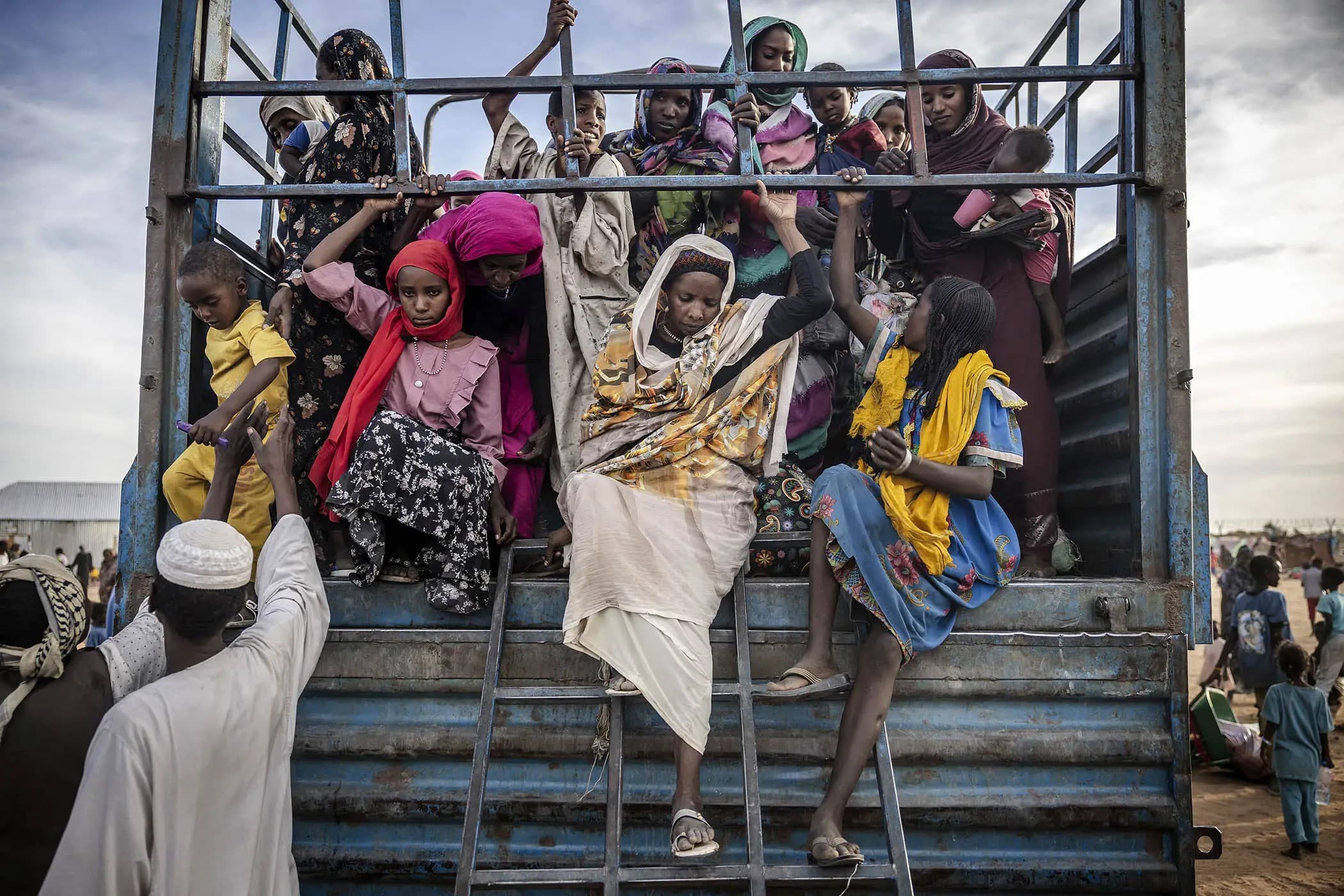
More than 150,000 people have been killed since the war began, though some estimates now reach as high as 400,000. Nearly 15 million people have been forced from their homes — a displacement figure that has no precedent in the world today. Of those, around 4.4 million have crossed into Chad, Egypt, and South Sudan. The rest are internally displaced, many of them living in areas where markets have collapsed, health facilities are shuttered, and clean water is a daily gamble.
Approximately 34 million people, 65 percent of Sudan's entire population are in urgent need of humanitarian support. Twenty-four million face food insecurity. In the agricultural heartlands of Darfur, Kordofan, and Gezira, some regions have recorded harvest losses of nearly 50 percent. Sudan, once described as Africa's potential breadbasket—a country with 19.8 million hectares of arable land and access to a fifth of the Nile's water resources—is watching its food systems disintegrate in real time. And yet, funding tells a different story. The 2026 humanitarian response plan requires 3 billion USD. Current funding sits at roughly 16 percent of that. A Berlin donor conference this week aimed to raise 1 billion USD—down from 4.2 billion USD sought in the 2025 plan, not because needs have fallen, but because donor ambition has. Sudan aid summits held in Paris and London in previous years both fell well short of their targets. The war in the Middle East continues to monopolise diplomatic attention and donor budgets, while Sudan bleeds quietly.
The Economy That Conflict Ate
Before the war, Sudan's economy was fragile but not without potential. It was the fourth-largest among Africa's low-income countries. Since April 2023, that foundation has been systematically dismantled. The country lost an estimated 6.4 billion USD in GDP in 2023 alone, the year the war began. GDP contracted by 12 percent that year and continued to shrink in 2024. Approximately 7 million additional people were pushed into extreme poverty in a single year. Ninety percent of manufacturing capacity in Khartoum, Gezira, Darfur, and Kordofan—where two-thirds of Sudan's industrial base was concentrated—has been destroyed. Agricultural yields dropped by 15 percent in 2023, with millet production falling by 50 percent. Annual inflation reached 170 percent in 2024. Public debt stood at 148 percent of GDP. The government's ability to deliver any services—health, water, education, security—has been gutted.
The report's baseline scenario, which assumes peace by 2026, projects average GDP growth of just 1.2 percent annually through 2043. That is less than a quarter of the average growth rate of Africa's low-income countries. GDP per capita is expected to remain below early-1990s levels well into the 2040s. Extreme poverty, on this path, will affect nearly 40 percent of the population by 2043. In concrete terms: Sudan is not just losing a decade. It is losing several.
Perhaps the most painful measure of this war's depth is what it has done to children. More than 19 million school-aged children have had their education disrupted. Only 20 percent of schools are currently operational. The rest have been destroyed, repurposed as shelters, or occupied by armed groups. Teachers go months without pay. Families already stretched to breaking point cannot afford uniforms, transport, or the absence of a child who might otherwise earn or farm. Girls are bearing a disproportionate share of this burden. Since the war began, girls are dropping out of school at 2.5 times the rate of boys. Child marriage has increased as a survival strategy in displaced communities. Those who do leave school after conflict rarely return. The report notes that by 2043, on the current trajectory, there will be only 78 female students for every 100 male students at university—a gender gap that did not exist in 2022. An entire cohort of young Sudanese women is being quietly written out of their country's future.
The Health System That Is No Longer There
Two-thirds of Sudan's population currently have no access to essential health services. Thirty-five percent of women lack access to reproductive health care. Fifty-five percent of children are at risk from preventable diseases. Cholera, malaria, dengue, and measles are spreading through displaced communities where vaccination campaigns have collapsed and sanitation infrastructure has been destroyed. In the first three months of 2026 alone, nearly 700 civilians were killed in drone strikes—many of them near markets, schools, and health facilities.
The report documents 3,396 survivors of sexual violence who sought treatment in MSF-supported facilities across North and South Darfur between January 2024 and November 2025. In 87 percent of verified incidents of gender-based violence, the perpetrators were RSF fighters. These are the texture of what this war is doing to Sudanese women, systematically and deliberately.
What Continuing This War Costs
The report's Protracted Conflict scenario—which models what happens if fighting continues to 2030—produces numbers that should stop any policymaker in their tracks. By 2043, Sudan's GDP would be 34.5 USD lower than it would be in a no-conflict scenario. GDP per capita would be roughly 1,700 USD less per person. Extreme poverty would exceed 60 percent of the population, with 34 million more people in deprivation than if the war had never happened. These are not speculative projections. They are the compounding mathematics of a country being dismantled year by year.
Against this, the report offers the Sudan Rising scenario: what becomes possible if peace is restored and coordinated reforms are pursued across governance, agriculture, health, education, infrastructure, and trade. Under this pathway, GDP reaches 58.2 billion USD by 2043—nearly 20 billion USD above the current trajectory. Average growth accelerates to 5 percent. Life expectancy rises by 4.2 years. And 17.3 million people are lifted out of extreme poverty.
The Window Is Narrowing
What the report makes clear, and what the fourth anniversary of this war demands we say plainly, is this: peace is necessary, but peace alone will not be enough. Sudan will need a genuine political settlement, the restoration of functioning state institutions, and a coherent, data-driven development agenda that prioritises governance reform, agricultural transformation, and inclusive economic recovery. It will also need international partners who remain at the table long after the cameras leave. Sudan ranks 170th out of 193 countries on the Human Development Index. It has been called the most neglected crisis of 2025. It is entering its fourth year with no ceasefire in sight, funding at a fraction of what is needed, and a generation of children who have spent their formative years not in classrooms, but in displacement camps, rubble, and fear.